SEO vs AEO vs GEO:
What’s the Difference and Why It Matters


Nov 26, 2025
Introduction
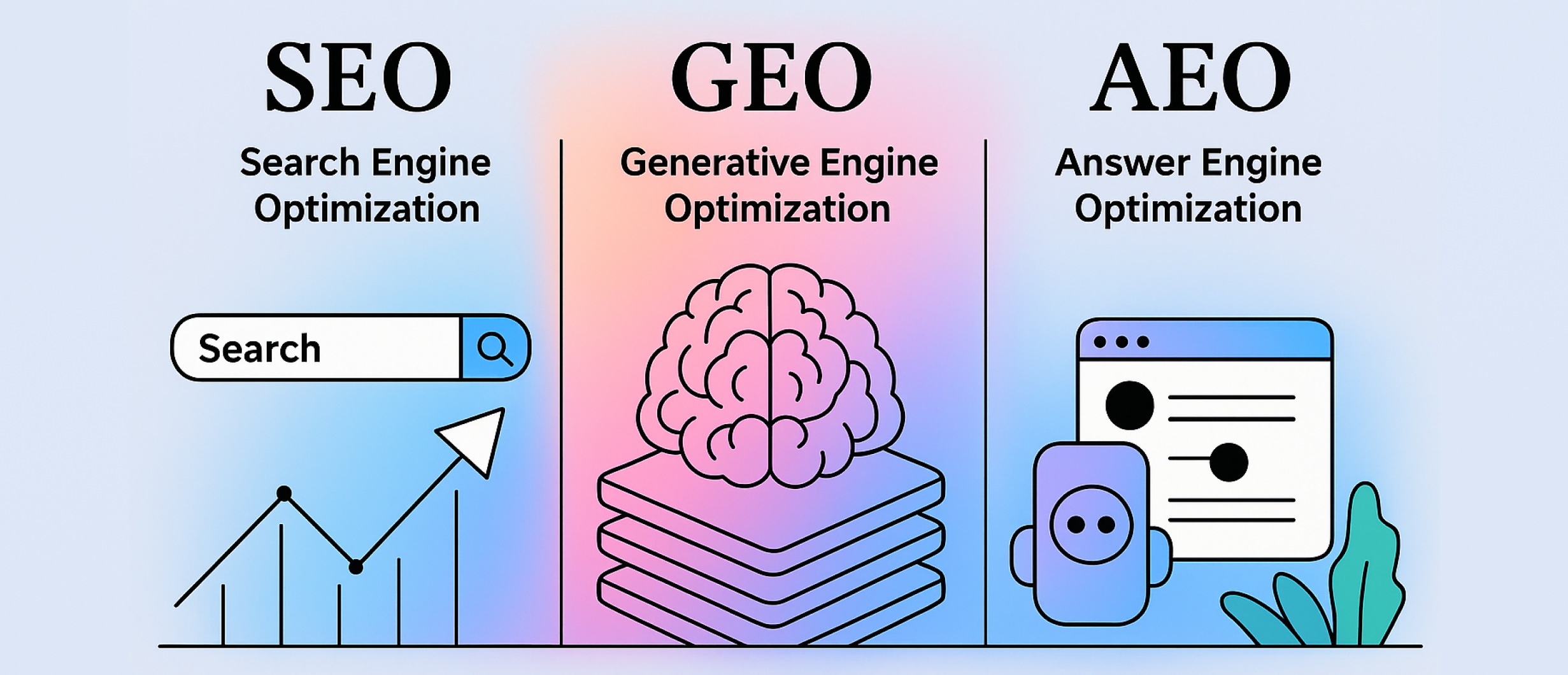
The way people search for information online is changing faster than ever. Ten years ago, the focus was mainly on SEO (Search Engine Optimization), getting your website ranked on Google. Then came AEO (Answer Engine Optimization), where users expect direct answers from snippets and voice assistants. Now, with AI tools like ChatGPT, Google AI Overviews, and Perplexity, a new concept called GEO (Generative Engine Optimization) is reshaping how content gets discovered.
Let’s break each one down with examples and see how they work.
⇛ SEO (Search Engine Optimization)
🔸What it is:
SEO is the traditional method of improving your website’s visibility on search engines like Google, Bing, or Yahoo. It’s all about making sure your site shows up when someone types a query related to your business or content. Search engines use algorithms that look at things like keywords, backlinks, site performance, and user experience to decide where your page ranks. In simple terms, SEO is about speaking the search engine’s language so it can recommend your site to users.
🔸Example:
If someone searches “best coffee shops near me”, SEO helps ensure your cafe’s website shows up on the first page of results.
🔸Why it matters:
Higher rankings = more visibility = more traffic
⇛ GEO (Generative Engine Optimization)
🔸What it is:
GEO is the latest evolution, designed for generative AI platforms like ChatGPT, Perplexity, or Google AI Overviews. These engines don’t just retrieve answers, they generate them by combining data from multiple sources. GEO focuses on making your content recognizable and reliable for AI models, so when they create summaries or comparisons, your content is included or cited. It’s less about ranking and more about becoming part of the knowledge that AI uses to respond to people’s questions.
🔸Example:
If someone asks any LLM model to “Compare iPhone 17 Pro vs Samsung S25 Ultra”, the AI will pull from various sources. If your review is optimized for GEO, it might be cited or referenced in that generated response.
🔸Why it matters:
As more people turn to AI chatbots instead of Google, GEO will play a massive role in visibility and brand trust.
⇛ AEO (Answer Engine Optimization)
🔸What it is:
AEO takes SEO a step further. Instead of just trying to appear in the list of search results, the goal is to be the answer that platforms like Google, Siri, Alexa, or even Google’s “People Also Ask” box select and display directly. Think of it as optimizing for questions instead of keywords. AEO content is structured, straightforward, and formatted so machines can instantly pull the answer without needing the user to click through multiple links.
🔸Example:
If someone asks Google Assistant “What is the capital of Japan?”, AEO helps your content be the one Google Assistant reads out: “Tokyo is the capital of Japan.”
🔸Why it matters:
Today’s users don’t always want to click links, they want fast and direct answers.
How SEO, AEO, and GEO Differ:
| Category | SEO | AEO | GEO |
|---|---|---|---|
| Purpose | Rank on search engines | Be chosen as the direct answer | Be included in AI-generated results |
| Main Strategy | Keywords, backlinks, technical SEO | Structured Q&A, schema markup | Authority, AI-friendly content, structured data |
| Content Style | Long-form, keyword-rich | Concise, factual, Q&A format | Conversational, contextual, multi-format (text, images, video) |
| Popular Style | Blog posts, guides, landing pages | FAQs, definitions, how-tos | Research-backed insights, detailed comparisons, authoritative sources |
Conclusion
SEO, AEO, and GEO aren’t competitors, they’re part of an evolving ecosystem. SEO gets your site noticed in traditional searches. AEO positions your content as the trusted answer for voice and snippet queries. GEO prepares your content to be recognized by AI-driven engines that summarize and generate insights.
For businesses and creators, the takeaway is clear: don’t just stick to SEO. Blend all three approaches. Write content that ranks, answers questions clearly, and is structured so AI tools can easily understand and reference it.
The future of search isn’t just about clicks, it’s about being found, heard, and trusted across every platform where people look for answers.