Business Development vs Sales in a Software Services Company


Feb 18, 2026
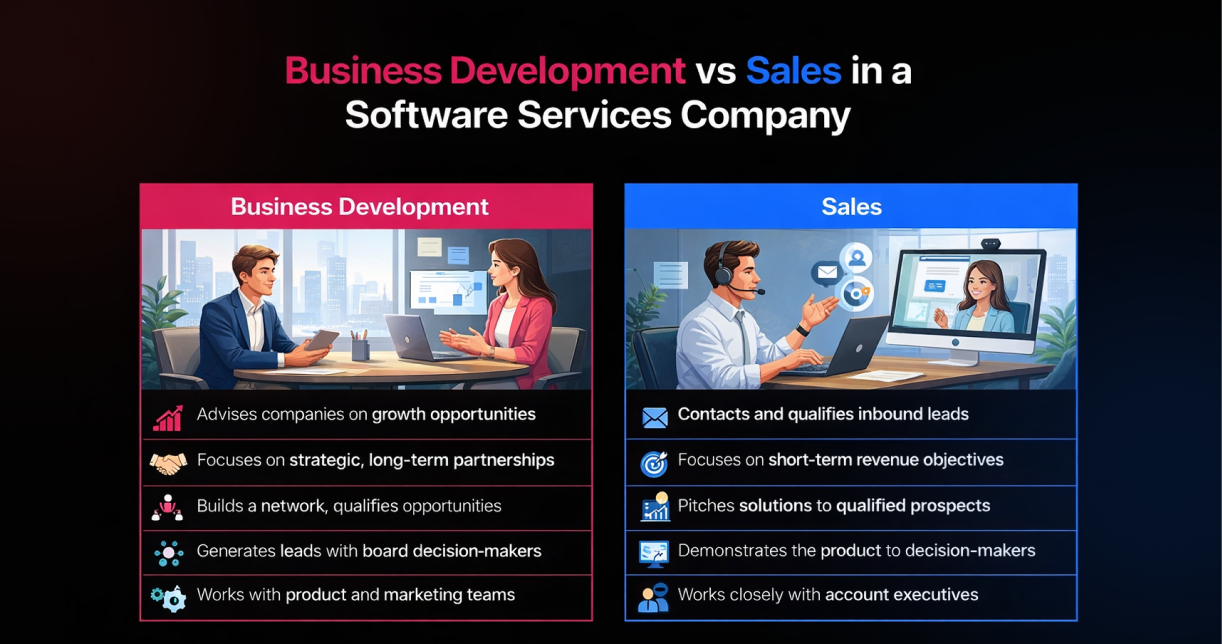
In software services companies, Business Development and Sales are often mixed up. Many people use the terms interchangeably, and Business Developers are frequently labeled as salespeople. On the surface, that confusion makes sense. Both roles exist to grow the company.
But if you look closely, they solve very different problems.
Sales is about closing deals.
Business Development is about creating the conditions where deals can exist in the first place.
Let’s break this down properly.
The Core Objective
➣ Sales:
The sales team is focused on revenue in its most direct form. Their job is to convert leads into paying customers. The faster and more consistently they can do that, the better the business performs in the short term.
➣ Business Development:
Business Development works at a wider level. The goal is long-term growth through relationships, positioning, partnerships, market expansion, and sometimes even internal initiatives like hiring or new offerings. Revenue still matters, but it is often a result, not the starting point.
How Sales Typically Works
Sales activities usually fall into inbound and outbound.
➣ Inbound Sales
Inbound sales begin when a potential client reaches out first. This usually happens because of marketing efforts like content, ads, referrals, or brand visibility.
➠ Once the lead arrives, the sales role is clear:
-
Understand the client’s needs
-
Run discovery calls
-
Prepare proposals
-
Handle negotiations
-
Close the contract
At this stage, success depends heavily on how well marketing has done its job before the lead ever spoke to sales.
➣ Outbound sales
Outbound sales work the other way around. The sales team actively reaches out to potential clients through cold emails, cold calls, LinkedIn outreach, or similar methods.
These campaigns are rarely random. They are usually based on patterns that have worked before, defined target profiles, and proven messaging. The focus is execution and volume, combined with follow-ups and persistence.
➣ Events and expos
Sales teams also represent the company at events. Their role is to attract interest, explain services or products, qualify leads, and push conversations toward future deals.
How Business Development Approaches Growth
Business Development also touches inbound and outbound, but the timeline and mindset are different. BD work starts much earlier and operates at a more strategic level.
➣ Inbound from a BD perspective
Inbound success does not start with marketing execution. It starts with deciding what the company should talk about and who it should attract.
➠ Business Developers work closely with marketing to:
-
Identify market trends
-
Spot rising technologies or business problems
-
Decide which industries to focus on
-
Shape messaging and positioning
This market insight defines the direction before a single campaign is launched.
➣ Relationships beyond direct sales
Another major difference is how BD views relationships. Not every conversation needs to lead to an immediate sale.
➠ A Business Developer may invest time in:
-
Potential partners
-
Consultants or advisors
-
Founders in adjacent industries
-
People with strong networks
These relationships may never turn into direct clients, but they often lead to referrals, introductions, or future opportunities. That indirect value is still inbound growth.
➣ Outbound at a strategic level
Outbound activities in Business Development start with research, not outreach.
➠ Before any campaign or event, BD teams:
-
Select the right industry
-
Study its biggest challenges
-
Identify where the company can genuinely add value
Only after this groundwork is done does execution begin, whether that is outreach, partnerships, or event participation.
➣ Events with intent
➠ When Business Development attends events, the goal is not just presence. It involves:
-
Researching attendees and companies in advance
-
Scheduling meetings before the event
-
Aligning expectations and objectives
-
Exploring new opportunities during the event itself
The event becomes a planned growth activity, not just networking.
Where Sales and Business Development Overlap
Business Development does not replace sales. It feeds sales.
In many companies, especially larger ones, roles are clearly separated. In smaller or growing organizations, Business Developers often participate directly in sales activities as well.
What matters is understanding that sales is one part of a much larger cycle.
Final Thoughts
Business Development operates at a broader and more strategic level. It shapes markets, builds relationships, and sets the stage for future revenue. Sales focuses on converting opportunities into contracts.
➠ In simple terms:
-
Sales executes
-
Business Development designs the playing field